
What Is an IUL Account? Financial planning today is about much more than simply saving money; it is about protecting your loved ones while building long-term wealth. People search for financial products that offer both life insurance protection and opportunities for tax-advantaged growth.
Indexed Universal Life (IUL) insurance has become an increasingly popular option. Often referred to as an IUL account, this type of permanent life insurance combines a lifetime death benefit with a cash value component that can grow based on the performance of a stock market index.
Unlike traditional life insurance policies, which only provide a death benefit, or standard savings accounts, which offer relatively modest returns, an IUL policy is designed to provide greater financial flexibility.
| Topic | Summary |
| What Is an IUL Account? | An Indexed Universal Life (IUL) account is a permanent life insurance policy that combines lifelong coverage |
| How It Works | Premiums pay for insurance costs, while the remaining amount builds cash value that earns index-linked interest. |
| Cash Value Growth | Cash value grows tax-deferred based on the performance of a selected |
| Market Exposure | Funds are not directly invested in the stock market; the insurer credits interest based on an index-linked formula. |
| Key Features | Lifetime coverage, flexible premiums, adjustable death benefit, cash value accumulation, and downside market protection. |
| Main Benefits | Permanent life insurance, tax-deferred growth, tax-free death benefit |
| Potential Risks | Higher fees, policy complexity, interest caps, surrender charges, and the possibility of policy lapse if insufficient cash value exists. |
| Who Should Consider It? | Individuals seeking permanent life insurance, supplemental retirement income, |
| Who May Not Benefit? | People looking for low-cost insurance, guaranteed investment returns, or short-term savings may find an IUL unsuitable. |
| Ways to Access Cash Value | Policy loans and partial withdrawals are subject to policy terms and potential tax consequences. |
| Important Costs | Insurance charges, administrative fees, rider costs, surrender charges, and other policy expenses can affect cash value growth. |
| Buying Tips | Compare insurers, understand policy fees and index crediting methods, review illustrations carefully, and consult a qualified financial professional before purchasing. |
What Is an IUL Account?

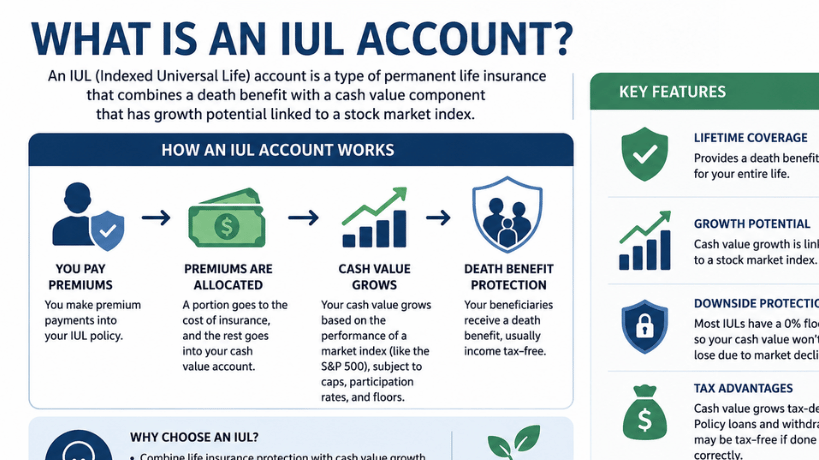
An Indexed Universal Life (IUL) account is a type of permanent life insurance policy that combines lifelong coverage with a cash value component that can grow over time. What is an IUL Account? Unlike traditional life insurance, an IUL allows part of your premium payments to accumulate as cash value.
with growth linked to the performance of a selected stock market index, such as the S&P 500. However, the money is not directly invested in the stock market. Instead, the insurance company credits interest based on the index’s performance while applying features such as participation rates, caps, and a minimum interest floor to help manage risk.
How Does an IUL Account Work?
An Indexed Universal Life (IUL) account combines permanent life insurance protection with a cash value account that can grow over time. Each time you pay a premium, a portion of that payment covers the cost of life insurance, administrative expenses, and other policy charges.
The remaining amount is deposited into the policy’s cash value account, where it earns interest based on the performance of a selected stock market index, such as the S&P 500. Although the cash value is linked to an index, the funds are not directly invested in the stock market, which helps protect against direct market losses while still allowing for potential growth.
Step 1: Pay Premiums
You pay premiums into your policy.
These payments cover:
- Insurance costs
- Administrative fees
- Policy expenses
- Cash value accumulation
Step 2: Build Cash Value

- Index-linked interest
- Tax-deferred growth
- Additional premium contributions
Step 3: Interest Is Credited
- S&P 500
- Nasdaq-100
- Dow Jones Industrial Average
- Russell 2000
Key Features of an IUL Account

Permanent Life Insurance
One of the biggest advantages of an Indexed Universal Life (IUL) account is that it provides permanent life insurance coverage rather than temporary protection. As long as you continue to meet the policy requirements and maintain enough cash value or pay sufficient premiums to cover the policy costs, your coverage can last for your entire lifetime.
Cash Value Growth
In addition to lifelong insurance protection, an IUL policy includes a cash value component that grows over time. A portion of each premium payment, after deducting insurance costs and policy fees, is credited to your cash value account. The growth of this cash value is linked to the performance of a selected stock market index.
Flexible Premiums
Many IUL policies allow you to:
- Increase payments
- Reduce payments
- Skip some payments if sufficient cash value exists
How Does an IUL Earn Money?

An Indexed Universal Life (IUL) account earns money by crediting interest to its cash value based on the performance of a selected stock market index, such as the S&P 500, Nasdaq-100, or another benchmark. Although the policy’s growth is linked to the movement of these indexes, the money is not directly invested in the stock market.
Instead, the insurance company uses a formula to determine how much interest is credited to your cash value each year. This approach allows policyholders to benefit from positive market performance while helping protect their savings from direct market losses.
Advantages of an IUL Account
Lifetime Coverage
One of the greatest benefits of an Indexed Universal Life (IUL) account is its lifetime coverage. Unlike term life insurance, which protects you for a limited number of years, an IUL policy is designed to remain in force for your entire life, as long as sufficient premiums are paid or the policy has enough cash value to cover its ongoing costs.
Tax-Deferred Growth
Another significant advantage of an IUL account is tax-deferred cash value growth. As the policy’s cash value increases through interest credited based on the performance of a selected market index, you generally do not pay annual income taxes on those earnings.
Tax-Free Death Benefit
An IUL policy also provides a tax-free death benefit to your beneficiaries in most cases under current U.S. tax law. When the insured person passes away, the life insurance proceeds are generally paid directly to the named beneficiaries without being subject to federal income tax.
Access to Cash Value
You may access money through:
- Policy loans
- Partial withdrawals
Who Should Consider an IUL Account?

An IUL may be appropriate for people who:
- Need permanent life insurance
- Have already maximized retirement account contributions
- Want tax-advantaged cash value growth
- Prefer downside protection over direct stock investing
- Have a long-term financial plan
Who May Not Benefit from an IUL?
What Is an IUL Account? While an Indexed Universal Life (IUL) account offers valuable benefits such as permanent life insurance, tax-deferred cash value growth, flexible premiums, and more, it is not the right financial solution for everyone. Individuals who are looking for the lowest-cost life.
Insurance coverage may find that term life insurance better meets their needs because it provides substantial death benefit protection at a much lower premium. Likewise, people who prefer straightforward savings or investment products with predictable returns may find an IUL too complex due to its participation rates, interest caps, policy charges, and cash value calculations.
Tips Before Buying an IUL Account

Before purchasing a policy:
- Compare quotes from multiple insurers.
- Review all policy fees.
- Understand participation rates, caps, and floors.
- Ask for illustrated projections using different market scenarios.
- Ensure the policy aligns with your long-term financial goals.
- Consult a qualified financial or insurance professional for personalized advice.
Conclusion
An Indexed Universal Life (IUL) account is more than just a life insurance policy—it is a long-term financial planning tool that combines permanent life insurance protection with the opportunity to build tax-deferred cash value linked to the performance of a market index.
What is an IUL Account? It has flexible premium options and adjustable death benefits. Downside market protection and potential for tax-advantaged growth make it an attractive choice for individuals who want both financial security and wealth-building opportunities.
However, an IUL is not a one-size-fits-all solution. Its performance depends on policy features such as participation rates, interest caps, insurance costs, and ongoing premium payments.
Want to know about Phantom Tax: The Complete Guide to Phantom Income, Works, Common Examples, Risks, Tax Rules Check out our Real Estate category.
FAQs
An IUL is a permanent life insurance policy with a cash value component, not a bank savings account.
You are generally protected from negative index returns by the policy’s floor, but fees and insurance charges can reduce your cash value.
It can provide supplemental retirement income for some people, but it should not automatically replace traditional retirement savings plans.
Withdrawals up to your policy basis are often tax-free, while policy loans are generally not taxable if the policy remains in force. Tax outcomes depend on individual circumstances and current tax law.
Most IUL policies are designed as long-term financial products and often work best when held for many years.