

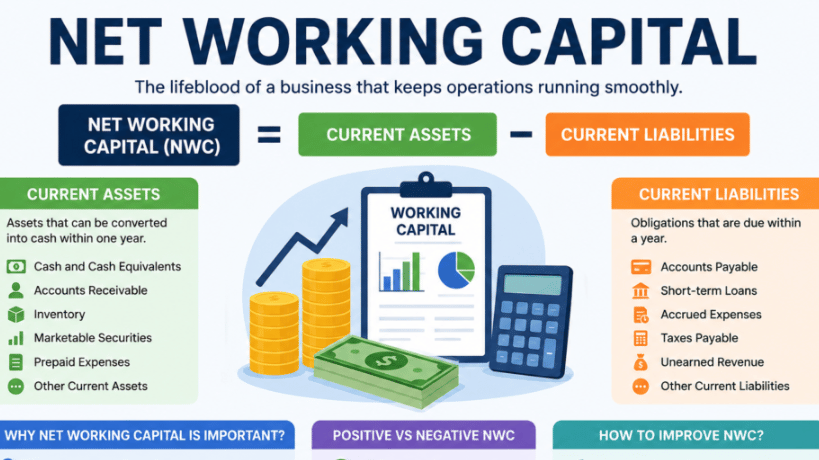
Every successful business depends on having enough cash and other short-term assets to keep its operations running smoothly. Whether it’s paying employees, purchasing inventory, settling supplier invoices, or covering everyday operating expenses, maintaining sufficient liquidity is essential for business stability and growth.
This is where net working capital (NWC) plays a critical role. As one of the most important financial metrics, net working capital helps measure a company’s ability to meet its short-term financial obligations while continuing to operate efficiently.
| Topic | Summary |
| Definition | A measure of a company’s short-term financial health by comparing current assets with current liabilities. |
| Formula | Net Working Capital = Current Assets − Current Liabilities |
| Current Assets | Cash, bank balances, accounts receivable, inventory, marketable securities, short-term investments, and prepaid expenses. |
| Current Liabilities | Accounts payable, short-term loans, taxes payable, salaries payable, utility bills, accrued expenses, and interest payable. |
| Positive NWC | Indicates the business has sufficient current assets to meet short-term obligations and operate efficiently. |
| Negative NWC | Suggests potential cash flow problems and difficulty paying short-term debts. |
| Example Calculation | Current Assets = £227,316; Current Liabilities = £136,390; Net Working Capital = £90,926 |
| Importance | Supports daily operations, improves cash flow, strengthens liquidity, and enhances financial stability. |
| Major Benefits | Better liquidity, improved supplier relationships, easier loan approvals, stronger creditworthiness, reduced financial risk, and greater investment opportunities. |
| Disadvantages of Excessive NWC | Idle cash, excess inventory, lower returns on investment, higher storage costs, and inefficient use of resources. |
| Common Management Mistakes | Holding too much inventory, slow customer collections, poor credit management, excessive borrowing, and weak cash flow forecasting. |
| Best Management Practices | Monitor cash flow regularly, collect receivables quickly, optimize inventory, negotiate supplier payment terms, reduce unnecessary expenses, and review financial reports frequently. |
| Who Uses NWC? | Business owners, financial managers, investors, lenders, creditors, accountants, and financial analysts. |
| Key Takeaway | Maintaining it helps businesses meet short-term obligations, improve profitability, support growth, and achieve long-term financial success. |
What Is Net Working Capital?

Net Working Capital (NWC) is a financial metric that measures a company’s short-term financial health and operational efficiency. It represents the difference between a business’s current assets—such as cash, accounts receivable, inventory, and other assets expected to be converted into cash within one year—and its current liabilities, including accounts payable, short-term loans, accrued expenses, and other obligations due within the same period.
The formula is simple: Net Working Capital = Current Assets − Current Liabilities. A positive net working capital indicates that a business has sufficient current assets to cover its immediate financial obligations. In contrast, a negative net working capital may suggest potential cash flow challenges or liquidity issues.
Understanding Current Assets
Current assets are resources expected to be converted into cash or used within one year.
Examples include:
- Cash
- Bank balances
- Accounts receivable
- Inventory
- Marketable securities
- Short-term investments
- Prepaid expenses
Understanding Current Liabilities
Current liabilities are a company’s short-term financial obligations due within one year or its normal operating cycle. These liabilities represent the debts and expenses a business must pay using its current assets, such as cash or accounts receivable.
Properly managing current liabilities is essential for maintaining healthy cash flow, meeting financial commitments on time, and avoiding liquidity problems. Businesses with well-controlled current liabilities are generally better positioned to operate efficiently and maintain strong relationships with suppliers, lenders, and employees.
Net Working Capital = Current Assets – Current Liabilities

Example 1
Current Assets = £227,316;
Current Liabilities = £136,390
Net Working Capital =
£90,926
Net Working Capital = £90,926
Example 2
Current Assets = £227,316;
Current Liabilities = £136,390
Net Working Capital =
£90,926
Components of Net Working Capital
Current Assets
- Cash
- Accounts receivable
- Inventory
- Short-term investments
- Marketable securities
- Prepaid expenses
Current Liabilities
- Accounts payable
- Short-term borrowings
- Taxes payable
- Salaries payable
- Utility bills
- Interest payable
Why Is Net Working Capital Important?
Net Working Capital (NWC) is one of the most important indicators of a company’s short-term financial health and operational efficiency. It shows whether a business has sufficient current assets to cover its current liabilities and continue funding its day-to-day operations.
A healthy level of net working capital allows a company to pay suppliers and employees on time, purchase inventory, meet unexpected expenses, and invest in growth opportunities without relying heavily on additional borrowing. It also helps maintain steady cash flow, reduces the risk of financial distress, and improves overall business stability.
Importance of Net Working Capital for Businesses

Maintain Daily Operations
Adequate net working capital ensures that a business can continue its day-to-day operations without financial interruptions. It provides the funds needed to pay employees, purchase inventory, cover utility bills, pay rent, and meet other routine operating expenses.
Improve Cash Flow
Healthy networking improves cash flow by ensuring sufficient liquid assets to meet short-term financial obligations. Businesses with strong cash flow can pay suppliers on time, respond to unexpected expenses, and maintain stable operations without relying heavily on short-term borrowing.
Increase Profitability
Efficient working capital management helps reduce unnecessary financing costs, interest expenses, and late payment penalties. By managing inventory effectively, collecting receivables promptly, and controlling short-term liabilities
Advantages of Positive Net Working Capital
Businesses enjoy several benefits:
- Better liquidity
- Improved supplier relationships
- Higher credit ratings
- Easier loan approvals
- Greater investment opportunities
- Financial stability
- Lower bankruptcy risk
- Improved operational efficiency
Disadvantages of Excessive Working Capital

While having positive net working capital is generally beneficial, excessive working capital can indicate that a company is not using its resources efficiently. When too much money is tied up in cash, inventory, or accounts receivable, those funds are not being invested in activities that could generate higher returns, such as business expansion, research and development, marketing, or new equipment.
Excessive working capital may also signal poor inventory management, slow collection of customer payments, or an overly conservative financial strategy. As a result, the business may experience lower profitability, reduced return on investment, higher storage and maintenance costs, and an increased risk of inventory becoming obsolete.
Common Mistakes in Working Capital Management
Businesses often make mistakes that reduce working capital.
Examples include:
- Holding excessive inventory
- Poor credit control
- Late customer collections
- Excessive borrowing
- Weak cash flow forecasting
- Overspending on unnecessary assets
Best Practices for Managing Net Working Capital

Effective net working capital management helps businesses maintain healthy cash flow, meet short-term financial obligations, and support long-term growth. Companies should regularly monitor their current assets and current liabilities to identify potential cash flow issues before they become serious.
Best practices include collecting customer payments promptly, maintaining optimal inventory levels to avoid excess stock or shortages, negotiating favorable payment terms with suppliers, and carefully managing short-term debt. Preparing accurate cash flow forecasts, reducing unnecessary operating expenses, and using financial reports to track liquidity can also improve working capital efficiency.
Conclusion
Net working capital is much more than a simple accounting calculation—it is a vital indicator of a company’s financial health, liquidity, and operational efficiency. By comparing current assets with current liabilities, businesses can determine whether they have sufficient resources to meet short-term obligations while continuing to invest in daily operations and future growth.
Maintaining an appropriate level of net working capital enables companies to pay bills on time, manage inventory effectively, improve cash flow, strengthen supplier relationships, and reduce the risk of financial difficulties.
If you want to read an interesting article about it, explore our Real Estate category.
FAQs
Net working capital is the difference between a company’s current assets and current liabilities. It measures the funds available to support daily business operations.
It means a company has enough current assets to cover its short-term liabilities, indicating good liquidity and financial health.
Some businesses with rapid inventory turnover, such as grocery stores and fast-food chains, can successfully operate with negative working capital.
It helps businesses evaluate liquidity, manage cash flow, meet financial obligations, and support growth.
By collecting receivables faster, reducing excess inventory, controlling expenses, negotiating better payment terms, and managing cash efficiently.

