

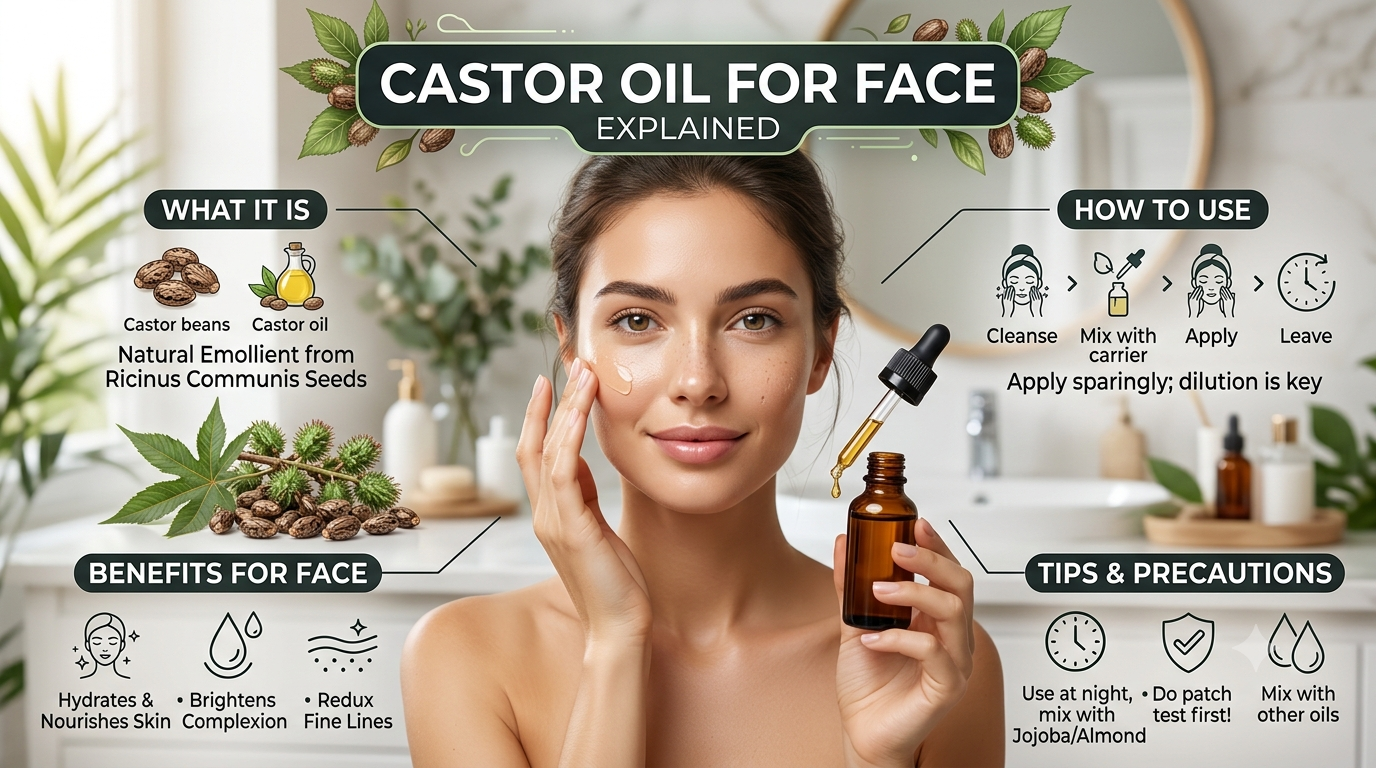
Castor oil works on the face as an occlusive moisturizer: it sits on the surface, slows water loss, and makes dry skin feel softer and look smoother within hours. That is the part with real support behind it. The popular claims — that it regrows eyebrows and lashes, “detoxes” the skin, shrinks pores or erases wrinkles — are not backed by clinical evidence. It is thick, sticky, and a known cause of allergic contact dermatitis in a small number of people, so patch testing is not optional.
This guide separates what castor oil actually does from what it is marketed to do, and shows how to use it without triggering breakouts or a rash.
What castor oil is, and what is in it
Castor oil is pressed from the seeds of Ricinus communis. What makes it chemically unusual among plant oils is ricinoleic acid, a hydroxylated fatty acid that makes up roughly 85–90% of its fatty acid content. Most cooking and cosmetic oils are dominated by oleic or linoleic acid; castor oil is the outlier, and that hydroxyl group is why it is so much thicker and stickier than jojoba, almond or squalane.
The seeds also contain ricin, a toxic protein, but it is water-soluble and stays in the pressed cake, so bottled castor oil is not a poisoning risk. The FDA recognizes castor oil for exactly one medical use — a short-term stimulant laxative — according to the NIH StatPearls monograph. There is no FDA-approved dermatologic indication.

What castor oil actually does for your face
It slows water loss (this is the real benefit)
Occlusive ingredients form a film that reduces transepidermal water loss. Castor oil is a good one: it is heavy and spreads into a continuous layer, so applied over damp skin it traps that water and dry patches improve fast. Same mechanism petrolatum uses, in a plant-derived form with a less greasy finish.
It supports the barrier indirectly
Castor oil does not rebuild ceramides or replace the lipids your skin makes. It buys the barrier time by cutting evaporation while the skin repairs itself — a genuine but modest benefit you would get from any occlusive. If your barrier is damaged from over-exfoliation or retinoids, a ceramide cream will do more, faster.
It softens texture and dissolves makeup
Oil dissolves oil. Castor oil breaks down sebum-based grime, sunscreen and long-wear makeup better than water-based cleansers, which is why it turns up in so many cleansing balms. Hydrated skin also reflects light more evenly, so the “smoother texture” people report after a few nights is real — it is hydration, not remodeling.
The anti-inflammatory and antimicrobial claims
Ricinoleic acid shows anti-inflammatory activity in lab and animal models, and undecylenic acid, a castor derivative, is a recognized antifungal. Lab activity is not a clinical effect on your face. No good human trial shows castor oil clears acne, calms rosacea or treats dermatitis. These are plausible mechanisms without proof, not benefits to count on.
What it does not do
- Grow eyebrows or eyelashes. No controlled trial has shown castor oil increases hair growth. Coated hairs look darker, thicker and glossier, which is a cosmetic effect that disappears when you stop. The only topical with FDA approval for lash growth is bimatoprost (Latisse), a prostaglandin analog.
- “Detox” anything. Skin does not release toxins through an oil pack. As Cleveland Clinic puts it bluntly, there is no scientific proof behind castor oil packing, and the clinic’s family medicine physician says he has never recommended castor oil to a patient.
- Shrink pores. Pore size is largely genetic and sebum-driven. Oils can make pores look temporarily softer; they do not change diameter.
- Erase wrinkles. Hydration plumps fine lines for a few hours. Nothing in castor oil has been shown to affect collagen. If that is the goal, a retinoid, daily sunscreen and possibly a device like a red light therapy mask have far more data behind them.
Cold-pressed, Jamaican black, or hydrogenated?
The label matters more than most people realize. Jamaican black castor oil (JBCO) is made by roasting the beans before pressing, which is what makes it dark and smoky-smelling; the residual ash leaves it more alkaline than cold-pressed oil. That higher pH is why JBCO is a poor fit for facial skin, which sits around pH 4.7–5.5. It suits the scalp, where a temporary pH shift matters less.
| Type | How it is made | Color and smell | Best use | Face-friendly? |
|---|---|---|---|---|
| Cold-pressed (hexane-free) | Mechanically pressed, no heat or solvents | Pale yellow, near-odorless | Facial oil, cleansing, dry patches | Yes — the default choice |
| Refined / expeller-pressed | Heat-pressed, often solvent-extracted then bleached | Clear, odorless | Mass-market cosmetics, soaps | Usually fine, but fewer minor constituents |
| Jamaican black (JBCO) | Beans roasted, pressed, boiled with ash | Dark brown, smoky | Scalp, edges, hair | Not ideal — more alkaline, more irritating |
| Hydrogenated castor wax | Hydrogen added to make it solid | White, waxy solid | Balms, sticks, mascara | As a formulated ingredient only |
For the face, buy cold-pressed, hexane-free castor oil in a dark glass bottle, and check the ingredient list reads only Ricinus communis seed oil. Blends with fragrance or essential oils raise the sensitization risk without adding benefit.

Is castor oil comedogenic? The honest answer
Castor oil is usually listed at 1 on the 0–5 comedogenic scale, meaning “very low.” That number deserves an asterisk. Those ratings come largely from a 1980s rabbit-ear assay — an animal model far more prone to forming comedones than human facial skin, testing raw ingredients rather than finished products. A 2025 clinical review in JAAD Reviews flagged exactly this: comedogenicity ratings are inconsistently derived, poorly regulated, and weak at predicting who will actually break out.
So treat the number as a starting point, not a verdict. Plenty of people use castor oil on the face with no breakouts; others, especially those with oily or acne-prone skin, get closed comedones along the jaw and hairline within two weeks. The only test that counts is your own skin, on a small area first.
How to apply castor oil to your face
1. Patch test before anything else
Apply a dab to the inside of the forearm or behind the ear, leave it 24 hours, and repeat for three days. Castor oil is a documented cause of allergic contact dermatitis, and reactions frequently appear on the second or third exposure rather than the first. Stop at any redness, itching or bumps.
2. Dilute it
Undiluted castor oil is heavy enough to feel tacky and to drag on the skin. Mix 1 part castor oil with 3 to 4 parts of a lighter carrier — jojoba, squalane, sweet almond or grapeseed. Dilution lowers the risk of irritation, spreads more evenly, and makes a bottle last far longer. Only people with very dry, non-reactive skin should consider using it neat, and even then only on specific patches.
3. Apply to damp skin, at night
Cleanse, leave the skin slightly damp, apply your usual hydrating serum or moisturizer, then press 2–4 drops of the diluted oil over the top with your fingertips. Occlusives work best as the last step. The AAD makes the same point for moisturizers generally: leave some water on your skin, then apply.
4. Or use it as an oil cleanse
Massage a diluted blend onto dry skin for 30–60 seconds, emulsify with warm water, then follow with a gentle water-based cleanser. This double cleanse removes sunscreen and makeup thoroughly and rinses the oil away, so nothing sits in pores overnight. For oily and acne-prone skin, it is the safer way to use castor oil.
5. Around the eyes — carefully
Castor oil is used on the eyelid margin in eye care, and the evidence there is more interesting than the beauty claims. A 2020 randomized trial in The Ocular Surface tested periocular castor oil for blepharitis, and a 2025 ex vivo study in Contact Lens and Anterior Eye found activity against Demodex mites. A University of Auckland team led by Professor Jennifer Craig launched a larger double-blind eyelid trial in 2024 after a 26-person pilot showed less lid redness and crusting.
That research uses purpose-made ophthalmic preparations on the lid margin. It is not a green light to put cosmetic castor oil in your eyes. Keep it on the skin, use a clean applicator, and stop if you get stinging or blurred vision.

Which skin types benefit most
| Skin type | Verdict | How to use it |
|---|---|---|
| Dry / dehydrated | Best candidate | Diluted 1:3, over moisturizer, nightly |
| Normal | Fine occasionally | 2–3 nights a week, or as a cleansing oil |
| Combination | Spot use only | Cheeks and around the mouth; skip the T-zone |
| Oily / acne-prone | Higher risk | Rinse-off cleansing only, if at all |
| Sensitive / eczema-prone | Caution | Patch test twice as long; a ceramide cream is a better bet |
| Rosacea | Generally avoid | Heavy occlusives and friction can flush the skin |
Very dry skin in winter is where castor oil earns its keep. If you are mainly chasing all-over body dryness rather than facial dryness, a formulated cream is more practical — see our picks for the best body lotions.

Side effects and who should skip it
- Allergic contact dermatitis. Case reports link castor oil and its derivatives to allergic reactions ranging from mild itch to angioedema-like swelling. It is uncommon, but it is the single most important reason to patch test.
- Clogged pores and closed comedones. Most likely along the jaw, chin and hairline, and most likely if you sleep in it.
- Milia. Heavy oils under the eyes can contribute to small white cysts in some people.
- Eye irritation. Blurred vision and stinging if it migrates into the eye.
- Stained bedding. Trivial, but real. Use an old pillowcase.
Pregnancy: topical is not the same as oral
The pregnancy warnings attached to castor oil are about swallowing it. Oral castor oil is a stimulant laxative that can trigger uterine contractions and is listed as contraindicated in pregnancy. A small amount on facial skin is a different exposure, and absorption through intact skin is minimal. Even so, clear any new topical with your OB, and never drink castor oil to bring on labor without medical supervision.
Common mistakes to avoid
- Using it undiluted on the whole face. Heavy, tacky, and more likely to congest pores.
- Applying it under sunscreen or makeup. It pills and disrupts SPF films. Save it for night, and keep your morning routine to a proper lightweight sunscreen for oily skin.
- Buying Jamaican black castor oil for the face. That grade is built for scalp and hair, where it does have a following for smoothing flyaways and edges.
- Skipping the patch test because “it’s natural.” Poison ivy is natural too.
- Expecting hair growth. You will get shine and weight, not new follicles.
- Layering it over an active. Occlusives increase penetration of whatever is underneath, which can turn a tolerable retinoid into an irritating one.
- Leaving it on after sweating. If you train early — fasted cardio or otherwise — cleanse first rather than sealing sweat and sunscreen under an oil layer.
Can you combine it with other skincare products?
Yes, with rules. Castor oil pairs well with humectants: apply hyaluronic acid or glycerin first, then the oil to seal. It also layers fine over a plain ceramide moisturizer.
Be careful with actives. Retinoids, benzoyl peroxide, azelaic acid and exfoliating acids should go on clean, dry skin and be given time to absorb; putting an occlusive straight on top can increase both effect and irritation. The simplest approach is to alternate — actives on some nights, oil on others. Do not mix castor oil into a benzoyl peroxide product; oils can interfere with the formulation.
Is castor oil safe for daily use?
For dry, tolerant skin, nightly use is reasonable once you have patch tested and diluted it. For everyone else, two or three nights a week is a better starting point, and rinse-off cleansing is safer than leave-on. Judge results at four to six weeks, and stop at the first sign of redness, itching or small bumps.
What to use instead, depending on your goal
| Your goal | Better-supported option |
|---|---|
| Acne | Benzoyl peroxide, adapalene, salicylic acid, azelaic acid; prescription options for moderate to severe acne |
| Dryness and barrier repair | Ceramide + cholesterol + fatty acid moisturizer; petrolatum for severe dryness |
| Fine lines | Daily broad-spectrum SPF 30+, a retinoid, vitamin C |
| Lash or brow growth | Bimatoprost (Latisse), the only FDA-approved topical for lashes; see a dermatologist for brow thinning |
| Makeup removal | A formulated cleansing balm or micellar water, then a gentle cleanser |
| Dark spots | Sunscreen plus azelaic acid, niacinamide or tranexamic acid |
Castor oil is a cheap, effective occlusive. It is not a treatment. If you have persistent acne, eczema or rosacea, a dermatologist and an evidence-based active will get you further than any single-ingredient oil.
Frequently asked questions
Can I leave castor oil on my face overnight?
If your skin is dry and you have patch tested, yes — use a diluted blend as the last step of your routine. If your skin is oily or acne-prone, use it as a rinse-off cleansing oil instead. Sleeping in a heavy occlusive is the most common way people end up with closed comedones along the jaw and hairline.
Does castor oil clog pores?
It is rated 1 out of 5 on the comedogenic scale, but that scale comes from an old rabbit-ear assay and predicts individual breakouts poorly. Some people use it with no problem; others congest within two weeks. Test on a small area for two to three weeks before committing to full-face use.
Will castor oil grow my eyebrows or eyelashes?
No controlled study has shown that it does. Coating hairs makes them look darker and thicker, and that effect vanishes when you stop. Bimatoprost is the only FDA-approved topical proven to lengthen lashes. If your brows are thinning noticeably, get the cause checked rather than treating it with oil.
Should I dilute castor oil, and with what?
Yes. Mix roughly 1 part castor oil to 3 or 4 parts of a lighter oil such as jojoba, squalane, grapeseed or sweet almond. Dilution reduces tackiness, spreads more evenly and lowers irritation risk. Skip fragrance and essential oils, which add sensitization risk with no skincare benefit.
Is castor oil safe on the face during pregnancy?
The serious pregnancy warnings apply to swallowing castor oil, which acts as a stimulant laxative and can provoke contractions. Small topical amounts on the face are a different exposure and are not known to carry that risk. Still, clear any new product with your OB, and never take it orally to induce labor without medical supervision.
Cold-pressed or Jamaican black castor oil for the face?
Cold-pressed, hexane-free. Jamaican black castor oil is roasted and processed with ash, which raises its pH above what facial skin prefers and makes irritation more likely. Save JBCO for the scalp and hair, and look for a single-ingredient cold-pressed oil in dark glass for your face.
How long before I see results?
Hydration and softness show up within a day or two, because that is a surface effect. Anything beyond that — texture, tone, comfort — needs four to six weeks of consistent use to judge fairly. If you see redness, itching or new bumps at any point, stop and reassess rather than pushing through.
Can I use castor oil on my eyelids?
On the lid skin and lash line, cautiously, with clean hands and a small amount. Research on periocular castor oil for blepharitis and Demodex is genuinely promising, but it uses ophthalmic-grade preparations. Never drop cosmetic castor oil into the eye itself, and stop if you get stinging, blurred vision or swelling.