

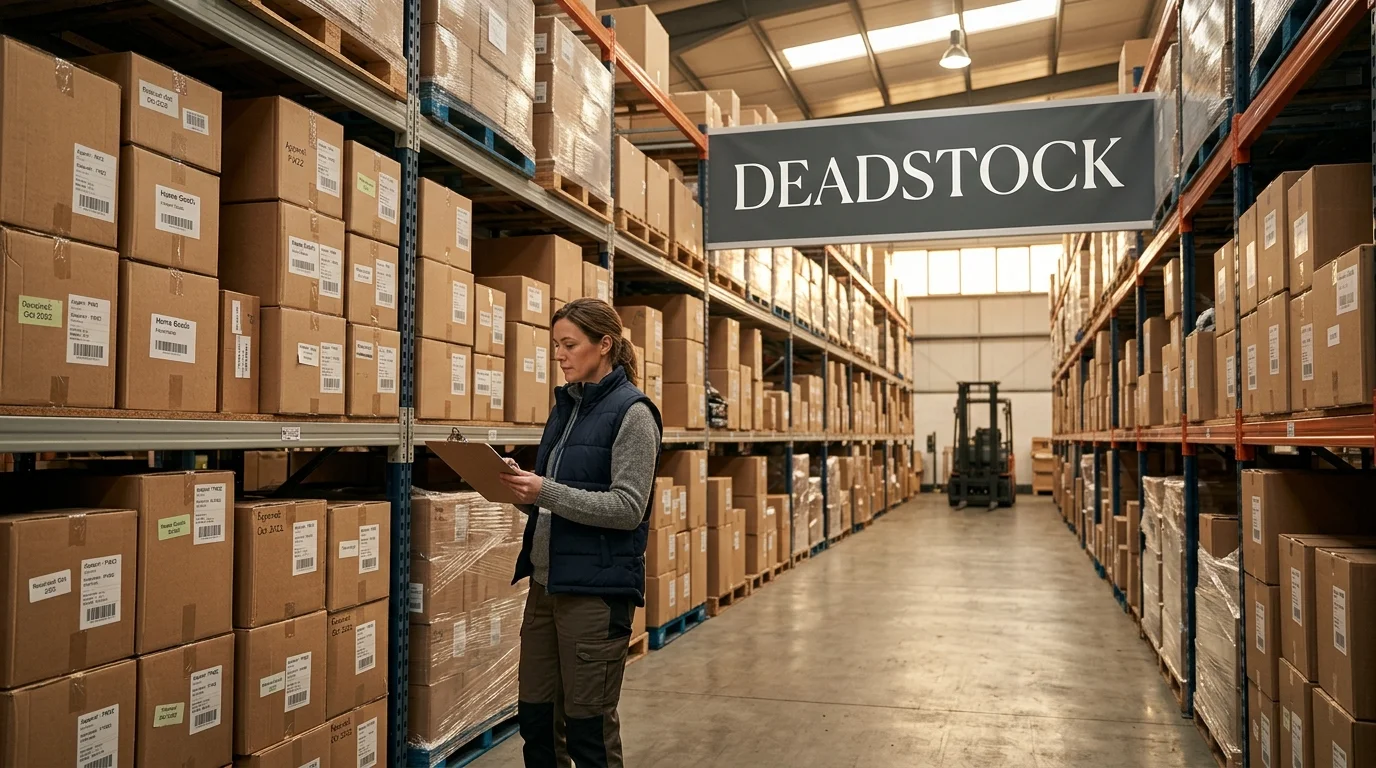
Two people can use the same word and mean opposite things. One is a store owner staring at 400 winter jackets nobody bought. The other is a collector paying extra for sneakers nobody has ever worn. Both of them are talking about deadstock.
The short answer: in retail, the word describes goods a business bought or produced and then failed to sell, so cash sits frozen on a shelf. In sneaker and vintage circles, the same word describes an unworn item still in its original box, and that status pushes the price up rather than down.
| Sense | Who uses it | What it points at | Effect on price |
|---|---|---|---|
| Retail and supply chain | Buyers, warehouse staff, finance teams | Goods bought or made that stopped selling | Drags the price down through markdowns |
| Sneaker and streetwear resale | Collectors and marketplace sellers | An unworn pair with tags and box intact | Pushes the price up, often past retail |
| Fashion textiles | Designers, mills, small labels | Leftover fabric rolls a mill never used | Cheap yardage, contested green claim |
Key takeaways
- One word, two industries, two opposite verdicts on what the goods are worth.
- In a warehouse it means frozen cash. In a resale listing, it means an unworn item in its box.
- Most retailers treat 90 days of zero sales as the first alarm and 365 days as terminal.
- Holding costs run roughly 20 to 30 percent of unit cost every year.
- DS and VNDS are condition grades, not guarantees, and sellers apply them loosely.
Where the term came from, and why it split in two

Accountants wrote “dead stock” as two words long before sneakers had a resale market. It described goods on the books that had stopped moving. The label mattered because those goods still counted as an asset while behaving like a liability.
Sneaker culture borrowed the phrase in the 1980s and 1990s. Collectors hunted the back rooms of small-town shops for old pairs that never sold. Those pairs were unsold, so by definition nobody had worn them, and unworn was the prize. The compliment attached to the shoe, not to the balance sheet.
That history explains the split you still see. Written as two words, it usually signals a problem. Written as one word in a listing, it usually signals a find. Nobody enforces the spelling, so read the context before you read the letters.
Why it piles up in the first place
Nothing exotic causes this. Four ordinary decisions do most of the damage.
- Forecasts built on last year’s winner rather than this year’s demand.
- Supplier minimums that force 500 units when the store needed 200.
- Size and color curves that ignore what actually sold last time.
- A trend that dies mid-season and strands the reorder.
How long stock has to sit before it counts as dead
No legal cutoff exists. Every business picks a threshold that matches how fast its category turns over.
Slow movers still sell, just rarely. Dead units have flatlined. The difference between the two shows up on the aging report, which sorts every SKU by days since its last sale.
- 0 to 90 days. Normal for most apparel. Watch it; do nothing yet.
- 90 to 180 days. Slow-moving. Fast-turn retail already calls this a problem.
- 180 to 365 days. At risk. Wholesale and spare parts often still tolerate it.
- 365 days and beyond. Dead in almost any category.
Those aging thresholds matter for the books as well as the shelf. Your costing method decides what each leftover unit is worth on paper, and first-in, first-out inventory math values what remains at the newest prices. Cheaper older units clear first on paper. The stale ones at the back keep a higher book value than they deserve.
What unsold stock actually costs you

Storage is the obvious line. It is rarely the biggest one.
Carrying cost bundles warehouse space, insurance, handling, shrinkage, obsolescence, and the return you gave up by spending that money on those units. Most operators put it at 20 to 30 percent of unit cost a year. Here is a worked example using a mid-price jacket.
| Line | Figure |
|---|---|
| Units still on hand | 400 jackets |
| Cost per unit | $28 |
| Cash tied up | $11,200 |
| Carrying cost at 25 percent a year | $2,800 |
| Full retail price | $70 |
| Price at a 60 percent markdown | $28 |
| Cash recovered if the run clears | $11,200 |
Hold that stack one more year, and you burn $2,800 to keep goods that are then a season older. Clear it at a 60 percent markdown, and you recover what you paid today in cash you can spend on something that sells. The discount looks brutal on the price tag. On the yearly math, it wins.
That freed money has a name on the balance sheet. Stale units sit in current assets and quietly starve the rest of the operation, which is why cash locked into working capital is the number your accountant watches. Every dollar in a slow SKU is a dollar not buying a fast one.
How stores clear it without wrecking margins
The fastest exit is rarely the most profitable one, so most teams work down a ladder instead.
- Staged markdowns. Drop 20 percent, then 40, then 60. You find the price the market will pay instead of guessing it.
- Bundling. Attach the slow unit to a strong seller as a kit or a gift with purchase.
- Off-price and liquidation channels. You take cents on the dollar. The cash lands this quarter and the shelf empties.
- Return to vendor. Only works if you negotiated the clause up front, which is why that clause belongs in every new supplier deal.
- Donation. A registered charity takes the goods, and you claim the deduction, which beats paying to store them.
- Re-merchandising. Move it to another store, a different display, or a marketplace where demand never dried up.
One rule holds across all of them. Decide the exit before the units turn a year old, because every month you wait shrinks what anyone will pay.
What DS and VNDS mean on sneaker resale sites
Resale buyers needed a shared vocabulary for condition, and they built one before the platforms did. Listings on StockX, GOAT, and eBay lean on the same short codes.
| Grade | What the seller claims | What to check | Price effect |
|---|---|---|---|
| DS | Never worn, never laced, box and inserts intact | Sole texture, insole creasing, original laces | Top of the market |
| VNDS | Very near deadstock: tried on once or twice indoors | Toe crease, faint scuffing on the outsole | Roughly 10 to 20 percent below DS |
| Lightly used | Worn a handful of times and cleaned up well | Heel drag, yellowing on clear soles | Around half of a DS pair |
| Used | Regular wear, honest photos expected | Midsole compression, insole wear | Wearer prices, not collector prices |
| Beaters | Worn hard and sold that way on purpose | Whether the sole is still safe | Lowest tier |
Two cautions apply. Nobody audits these grades, so one seller’s DS is another seller’s return that somebody wore for an evening. A box that sat in a closet for fifteen years can also hide crumbling midsoles, and no condition code covers that.
Deadstock fabric and the greenwashing question

Small labels buy leftover mill rolls and market the result as sustainable. The logic is easy to follow. That fabric already exists, so cutting it beats letting it rot in a warehouse.
Critics push back on three points. Some mills now run deliberate overproduction because the leftovers resell at a profit, which turns waste into a product line. Brokers rarely disclose the original mill, so fiber content and dye chemistry stay unverifiable. And a brand can charge a premium for the eco story while changing nothing else about how it makes clothes.
Regulators have started paying attention. From 2026, the European Green Claims rules stop brands from labeling anything eco-friendly without evidence, so vague sustainability copy no longer passes. Volume is the other limit, since leftover rolls arrive in short mismatched lots. That suits a 60-piece capsule and fails a national rollout.
Trend speed is what fills those warehouses to begin with. A cut sells hard for two seasons and then stops, which is exactly what denim trend cycles keep doing to last year’s jeans. Buyers who chase the curve too late end up owning the tail of it.
Frequently asked questions
Usually not, although the spelling gives you no guarantee. Two words point to inventory that stopped selling. One word, in a resale listing, points to an unworn item that sells for more because of it. Read the surrounding sentence.
Fashion retailers commonly report 20 to 30 percent of a season’s buy failing to sell at full price. Trend-led categories sit at the top of that range. Basics and replenishment lines sit well below it.
No. Condition lifts the price only when demand already exists. An unworn pair of a shoe nobody wanted is still a shoe nobody wants, and the box adds nothing.
Only if your contract says so. You negotiate return-to-vendor terms up front, not after the season fails. Ask for them on every new line you take a real risk on.
A liquidator or an off-price channel moves the whole lot in weeks. You will take a hard loss per unit. Weigh that loss against another year of carrying cost before you rule it out.
Pull your aging report this week and list every SKU with no sale in 180 days. Put a dollar figure next to each one, then choose an exit for the worst ten before the quarter closes. Freeing that cash is the whole point.