
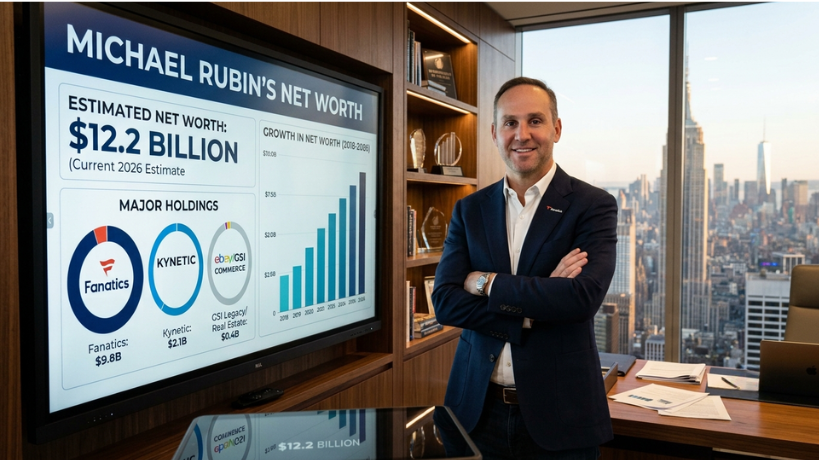
Michael Rubin’s net worth is estimated at roughly $9.5 billion to $11 billion in 2026. Forbes put him at $9.6 billion on July 3, 2026, ranking him #366 in real time and #362 on its 2026 Billionaires list. Celebrity Net Worth published $10 billion the same week, and the Grizzly Bulls billionaire index listed $10.0 billion on July 30, 2026.
Every one of those numbers is an outside estimate, not a disclosure. Almost all of Rubin’s wealth sits in one place: his stake in Fanatics, a private company that has never filed an S-1, never reported audited earnings publicly, and has not raised a priced round since December 2022. Nobody outside the cap table knows the number, including the people publishing it.
Quick facts
| Item | Detail |
|---|---|
| Full name | Michael G. Rubin |
| Born | July 21, 1972, Philadelphia, Pennsylvania |
| Age (August 2026) | 54 |
| Primary residence | Bryn Mawr, Pennsylvania (per Forbes) |
| Known for | Founder and CEO of Fanatics; founder of GSI Commerce |
| Education | Dropped out of Villanova University |
| Estimated net worth (Aug 2026) | $9.6B (Forbes, July 3, 2026); $10B (Celebrity Net Worth, July 3, 2026); $10.0B (Grizzly Bulls, July 30, 2026) |
| Source of wealth | Online retail; self-made (Forbes self-made score 8/10) |
| Main asset | Equity in Fanatics Inc., held through his holding company Kynetic |
| Fanatics last priced valuation | $31 billion (December 2022, $700M round) |
| Fanatics 2026 revenue forecast | ~$14 billion (Rubin, July 2026) |
| Philanthropy | Co-founder and co-chair, REFORM Alliance |
Where the 2026 estimates come from, and why they disagree
Three trackers publish a Michael Rubin number, and they do not match. That is not sloppiness. It is what happens when the underlying asset has no market price.
| Source | Estimate | Date | What it implies |
|---|---|---|---|
| Forbes real-time | $9.6 billion | July 3, 2026 | Forbes marks Fanatics at about $25 billion, below the last priced round |
| Celebrity Net Worth | $10 billion | July 3, 2026 | Rounded aggregate figure; methodology not published in detail |
| Grizzly Bulls index | $10.0 billion | July 30, 2026 | Daily-updating index, ranks him #332 globally |
| Bloomberg Billionaires Index | Published daily | Ongoing | Applies peer trading multiples to private holdings, so it moves with public comps |
| Widely repeated older figure | $11.5 billion | August 2024 | Reflects a period when Fanatics was still carried near its 2022 peak mark |
The gap between $9.6 billion and $11.5 billion is not a disagreement about Rubin. It is a disagreement about Fanatics.
How you value a private stake, and why the answer keeps moving
A public founder’s wealth is trivial to compute. Shares outstanding times today’s close, minus pledged stock. That is why an estimate for a listed-company founder like CrowdStrike’s George Kurtz can be refreshed every trading day and be roughly right every time. Rubin has no such price.
For Fanatics, an estimator has to build a valuation from scratch and then work out what slice Rubin owns. Four inputs drive the whole thing:
- The last priced round. Fanatics raised $700 million in December 2022 at a $31 billion post-money valuation, at $76.17 per share. That is still the most recent arm’s-length price on the company’s own paper.
- Secondary-market trading. Employee and early-investor shares change hands on private marketplaces. Forge Global listed a Fanatics price of $42.00 per share on July 9, 2026, down about 11 percent on the day. Against the $76.17 round price, that implies a company value near $17 billion, which is where private-market trackers such as PremierAlts currently mark it.
- Mutual fund marks. Public funds that hold private shares must report a fair value every quarter. Those marks have run far above the secondary tape at times; the research firm Sacra has read Fidelity’s filings as implying a Fanatics value above $33 billion in late 2025.
- Company-led tenders. Bloomberg reported in September 2024 that Fanatics was exploring a share tender at a discounted $25 billion valuation. Forbes appears to anchor to roughly that level today.
So the same company is simultaneously “worth” about $17 billion, about $25 billion, about $31 billion and above $33 billion depending on which window you look through. Multiply that spread by a founder stake and you get a multibillion-dollar error bar before you have made a single mistake.
Rubin’s ownership share is the second unknown. Forbes reported in both August 2020 and March 2021 that he owned “close to half” of Fanatics through Kynetic. Since then the company has raised $325 million in 2021, $1.5 billion in 2022 and $700 million in December 2022, plus issuing equity in acquisitions. All of that dilutes. Forbes now describes his position only as a minority stake, and no filing discloses the current percentage. Anyone quoting an exact number is guessing.
One more thing the estimates cannot see: Rubin’s stake is illiquid. He cannot sell it into a market on a Tuesday. Selling meaningful size means a tender, a secondary block at a discount, or an IPO. His paper wealth and his spendable wealth are different quantities, in the same way a company’s headline balance sheet and its net working capital tell you two different stories about what is actually available.
How Michael Rubin built the fortune: the milestones
| Year | Milestone | Why it mattered |
|---|---|---|
| 1984 | Starts a ski-tuning bench in his parents’ basement at age 12 | First business, run out of a Lafayette Hill, PA home |
| 1986 | Opens Mike’s Ski and Sport in Conshohocken, PA at 14, funded with $2,500 of bar mitzvah money | Grew to five locations while he was still in high school |
| 1988 | Runs up roughly $120,000 of debt by 16; his father lends him $37,000 | The near-failure Rubin still cites as his formative business lesson |
| 1993-1995 | KPR Sports, an athletic closeout business named for his parents, goes from $1M to $50M in sales; buys 40% of shoe brand Rykä | Proved he could move inventory at scale |
| 1998 | Founds Global Sports Inc., which becomes GSI Commerce | Pivot from selling goods to running other retailers’ e-commerce |
| Feb 2011 | GSI Commerce acquires Fanatics, a Jacksonville-based sports e-commerce operator | Brings the brand under his roof months before the exit |
| 2011 | Sells GSI Commerce to eBay for $2.4 billion | Rubin owned about 10% of GSI and personally netted roughly $150 million |
| 2011 | Buys the consumer businesses back from eBay for about $500 million | Forbes detailed it as $31M cash, $15M fees, $30M loan guarantees and a $467M low-interest eBay loan; he took 100% of Fanatics under his holding company Kynetic |
| 2012-2015 | $150M from Insight and a16z; $170M led by Temasek and Alibaba at $3.1B; $300M from Silver Lake | Turned Fanatics into a licensed-merchandise platform |
| Sept 2017 | SoftBank Vision Fund leads a $1 billion round at a $4.5 billion valuation | Funded the vertical manufacturing model |
| Aug 2020 | $350M round at $6.2 billion | Oversubscribed; Forbes had Rubin at $3.5B beforehand |
| Mar 2021 | $320M at $12.8 billion | Valuation doubled in seven months; Rubin’s Forbes estimate hit $6.2B |
| 2021 | $325M at $18 billion; Fanatics Collectibles and Fanatics Betting & Gaming created | The conglomerate strategy begins |
| Jan 2022 | Acquires Topps for about $500 million | Gave the collectibles arm a century-old brand and a factory |
| Apr 2022 | $1.5 billion round at $27 billion | |
| Dec 2022 | $700 million at $31 billion | Still the most recent priced round |
| Apr 2024 | Closes the acquisition of PointsBet’s US business for a $225 million headline price | Bought market access and trading technology |
| Dec 2025 | Launches Fanatics Markets, a prediction market, in 24 states with Crypto.com | Fifth revenue line |
| 2026 | Revenue tracking to ~$14B; Amex co-branded card announced May 20, 2026 | Rubin targets $30B-$50B of revenue within 5-10 years |
What Fanatics is actually worth and what it earns
Revenue is the cleaner number, because Rubin talks about it constantly. Fanatics did $8.1 billion in 2024, up about 16 percent. In a January 11, 2026 Forbes interview Rubin described Fanatics as “roughly a $13 billion business.” By July 2026 he was forecasting about $14 billion for the year and more than 150 million customers.
Here is the split, combining Rubin’s January 2026 comments with the segment figures he gave at the CAA World Congress of Sports in April 2026:
| Business | Approx. annual revenue | Notes |
|---|---|---|
| Commerce (licensed merchandise) | ~$7 billion | NFL ~$3B and MLB ~$3B; includes Lids retail and the Barnes & Noble campus partnership |
| Collectibles (Topps, cards, memorabilia) | ~$4-4.5 billion | Exclusive MLB, NBA and NFL card rights |
| Betting & Gaming | ~$1.6-2 billion | Sportsbook, casino and now prediction markets |
| Global soccer / international | ~$1.3 billion | Rubin calls this the most underdeveloped part of the company |
Valuation is the messy number. The company’s own last mark is $31 billion. The secondary market says something closer to $17 billion. Forbes uses about $25 billion. All three can be defended, which is exactly the problem for anyone trying to pin down Rubin’s fortune to the nearest billion.
Fanatics Collectibles and Topps
Fanatics created its collectibles arm in 2021 by signing exclusive long-term card deals with MLB, the NBA and the NFL, then bought Topps in January 2022 for roughly $500 million to get manufacturing and archives rather than build from zero. It has since added the auction house PWCC.
The NBA piece went live recently: Fanatics Collectibles, the NBA and the NBPA announced their multiyear partnership in October 2025, with 2025-26 Topps Basketball arriving October 23, 2025. It was Topps’ first NBA release since 2009-10, ending Panini’s run. Collectibles is now the fastest-compounding piece of the company and, at roughly $4.5 billion, arguably the single most valuable division.
Fanatics Betting & Gaming
This is the part of the story where the ambition and the scoreboard have not met yet. Fanatics Betting and Gaming closed its purchase of PointsBet’s US sportsbook, ADW and iGaming operations on April 3, 2024 at a $225 million headline price, picking up Banach Technology, a copy of PointsBet’s platform and more than 200 employees.
Two years later, Fanatics is a real but distant number three. Casino Reports data updated June 18, 2026 put Fanatics at 6.8 percent of national handle and 5.4 percent of gross gaming revenue across 20 mobile states. FanDuel held 35.6 percent of handle and 42.2 percent of GGR; DraftKings held 39.4 percent of handle and 36.8 percent of GGR.
Rubin’s own framing, from September 2025: betting could produce 40 percent of Fanatics’ profits by 2027, or “several hundred million dollars,” with the sportsbook reaching profitability that year once PointsBet is fully integrated. Fanatics also launched a casino product in May 2025 and Fanatics Markets, a prediction-market platform built with Crypto.com, on December 3, 2025 across 24 states. Rubin said in January 2026 it was doing about $1 million of handle a day. The company withdrew from the American Gaming Association over the prediction-market fight.
Will Fanatics go public?
Not yet, and not on a published timetable. Rubin told CNBC on June 13, 2025 there was “absolutely no rush,” that the company “never thought about going public” in 2022, and that “we want to build this as a great private company until it’s time to be a public company.” He also said Fanatics is profitable and holds about $1 billion of cash, so it does not need the money.
Sportico named Fanatics on its January 23, 2026 list of 2026 IPO maybes, noting that an offering is widely expected mainly as a liquidity route for investors who have been in since 2012. As of August 2026 Fanatics has not filed. Until it does, Rubin’s net worth stays an estimate.
What Rubin gave up to build the sportsbook
Rubin became a partner in Harris Blitzer Sports & Entertainment in 2011, holding roughly 10 percent of the group that owns the Philadelphia 76ers and the New Jersey Devils. On June 22, 2022 he announced he was selling, and completed the divestment later that year, with David Adelman buying a substantial share.
The reason was structural, not personal. “As our Fanatics business has grown, so too have the obstacles I have to navigate to ensure our new businesses don’t conflict with my responsibilities as part-owner of the Sixers,” he said. League rules and state gaming regulators do not let the same person own a piece of a team and run a sportsbook taking bets on it, and Fanatics was also signing individual player deals that cut across team interests. He walked away from eleven years of ownership in a franchise he grew up watching.
One correction worth making, because it is repeated often: Rubin did not sell a Crystal Palace stake. The Premier League club’s American investment came from Josh Harris and David Blitzer personally in December 2015, not through HBSE, so it was never part of Rubin’s holdings.
Beyond Fanatics: REFORM, Fanatics Fest and the White Party
REFORM Alliance
Rubin attended Meek Mill’s 2017 probation hearing expecting a formality and watched him sentenced to prison. In January 2019 he co-founded REFORM Alliance with Meek Mill, Jay-Z, Robert Kraft and others, and serves as co-chair. The organization targets probation and parole rules rather than sentencing. It says it has passed 23 bipartisan laws in 12 states affecting more than 850,000 people, and has raised more than $44 million through its 2023 and 2025 galas, including $20 million at the September 2025 event. This is the most consistent through-line in Rubin’s public life outside the company.
Fanatics Fest
Rubin launched Fanatics Fest in June 2024 as a Comic-Con for sports. The 2025 edition drew more than 125,000 people. The 2026 event ran July 16-19 at the Javits Center with close to 200,000 fans expected, American Express as presenting sponsor, and FIFA holding its World Cup Final press conference there, the first time that has happened away from the championship venue. Rubin told Boardroom the production costs $80 million to $90 million between Fanatics and its partners, roughly $10 million of it on athlete appearances, and that it is not a profit center: “This is where I give back to fans.”
The White Party
The all-white Hamptons party at Rubin’s Bridgehampton house has become a fixture of celebrity summer. He ran it from 2021 through 2024, skipped 2025, and brought it back on Wednesday, July 2, 2026, moved off its usual July 4 slot to avoid colliding with Taylor Swift and Travis Kelce’s wedding. Guests included Jay-Z, Travis Scott, Lil Wayne, Cardi B, Kevin Durant and Draymond Green. It is unpaid marketing of a kind almost no other retail CEO can buy, and it feeds directly back into Fanatics’ athlete relationships.
Real estate
Rubin bought 187 Dune Road in Bridgehampton for $50.1 million in 2020, the house where the White Party is held. In July 2026 he added the neighboring 167 Dune Road, an oceanfront property on 3.14 acres that had asked $42.5 million, according to The Real Deal. He also bought a Manhattan penthouse for $43.5 million in 2018 and a Los Angeles estate for a reported $70 million in 2022. Property is a real but small slice of a fortune that is overwhelmingly one private equity position.
Frequently asked questions
What is Michael Rubin’s net worth in 2026?
Estimates cluster between $9.5 billion and $11 billion. Forbes listed $9.6 billion on July 3, 2026, ranking him #366 in real time. Celebrity Net Worth published $10 billion the same week, and the Grizzly Bulls index showed $10.0 billion on July 30, 2026. All are estimates built on an assumed Fanatics valuation, not on any disclosure by Rubin.
How much of Fanatics does Michael Rubin own?
Not publicly disclosed. Forbes reported in 2020 and 2021 that he owned close to half of Fanatics through his holding company Kynetic. Rounds in 2021 and 2022 diluted that, and Forbes now describes it only as a minority stake. There is no filing that pins down the current percentage, so any precise figure you see is an estimate.
What is Fanatics worth in 2026?
It depends on the yardstick. The last priced round was $700 million at $31 billion in December 2022. Bloomberg reported a possible tender at $25 billion in September 2024, and Forbes appears to use roughly that. Secondary-market pricing on Forge was $42.00 per share on July 9, 2026, implying closer to $17 billion against the round price of $76.17.
How much revenue does Fanatics generate?
Fanatics reported $8.1 billion in 2024. Rubin described it as roughly a $13 billion business in January 2026 and forecast about $14 billion for 2026. The rough split is $7 billion in merchandise, $4 billion to $4.5 billion in collectibles, $1.6 billion to $2 billion in betting and gaming, and about $1.3 billion in global soccer.
Is Fanatics going public?
No filing yet. Rubin said in June 2025 there was “absolutely no rush,” that the company is profitable and holds about $1 billion in cash. Sportico included Fanatics on its January 2026 list of possible 2026 IPOs, largely because long-tenured investors want liquidity. Until an offering happens, no market price exists for Rubin’s shares.
Why did Michael Rubin sell his 76ers and Devils stake?
Conflict of interest. He held about 10 percent of Harris Blitzer Sports & Entertainment and announced the sale on June 22, 2022 because Fanatics was moving into sports betting and individual player partnerships. Gaming regulators and leagues do not permit team ownership alongside sportsbook operation. He had been an owner for eleven years.
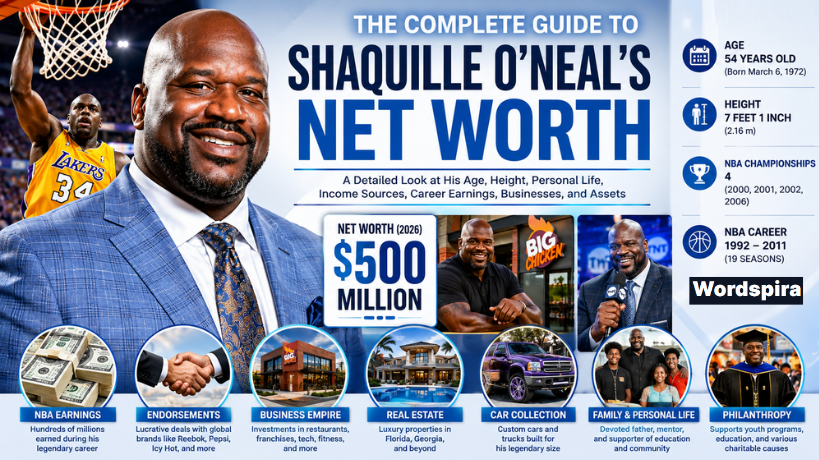
Is Michael Rubin richer than Shaquille O’Neal?
By a very wide margin. Rubin’s estimates run in the billions because he owns a large slice of a company doing $14 billion a year, while estimates of Shaquille O’Neal’s net worth sit in the hundreds of millions. The comparison is a useful reminder that operating equity, not salary or endorsements, is what produces ten-figure fortunes.
How reliable are celebrity net worth figures generally?
They vary enormously by subject. For a founder with a priced private stake, the estimate is at least anchored to real transactions. For entertainers with no disclosed holdings, such as the widely circulated figures for Bam Margera’s net worth, the numbers are often recycled guesses. Always check the date, the source and whether any actual transaction backs the figure.