

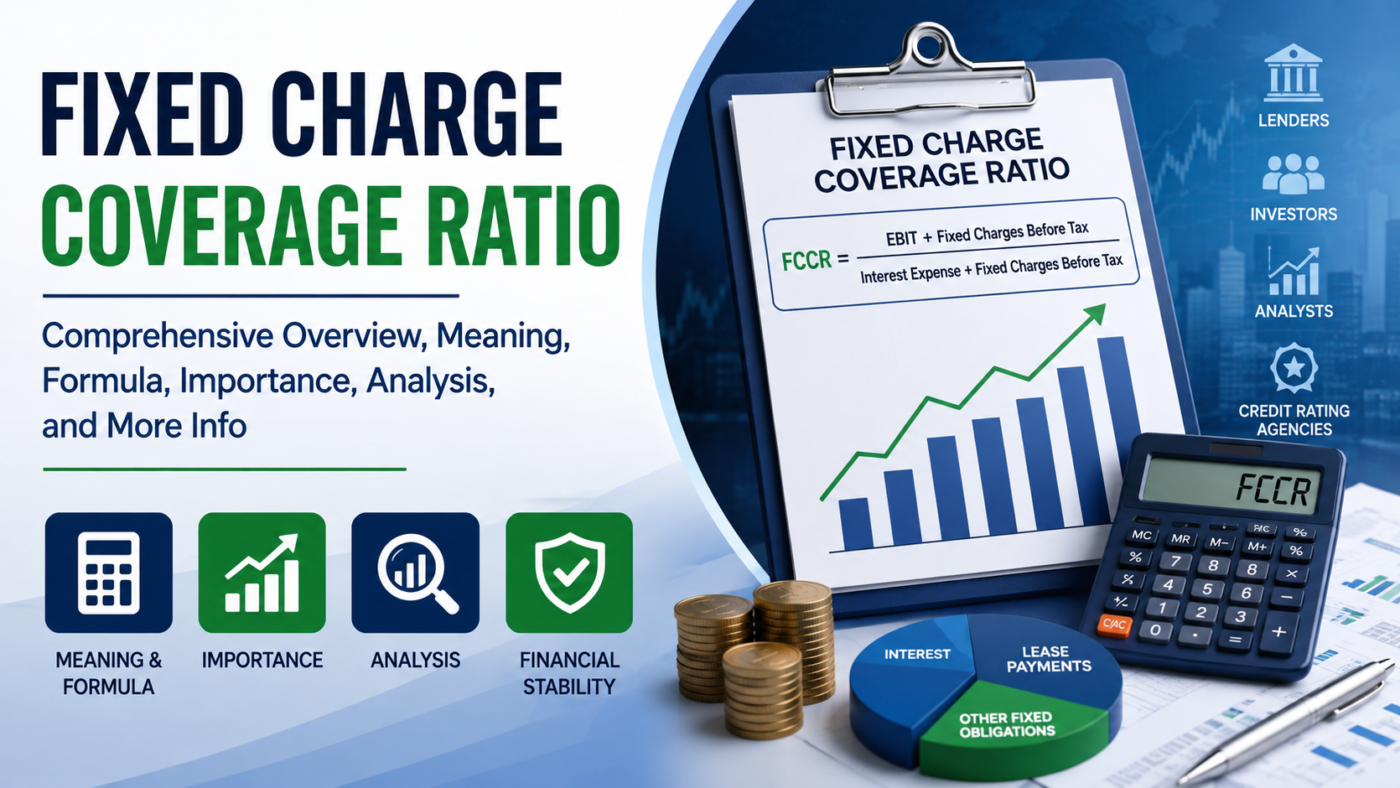
The fixed charge coverage ratio (FCCR) measures a company’s ability to meet fixed financial obligations using operating income (EBIT). Overall, it shows how easily a business can cover costs such as interest payments, lease expenses, and other long-term commitments. By including interest and fixed charges, the FCCR gives a more complete view of a company’s financial burden and stability.
Moreover, a higher ratio indicates strong financial health, while a lower ratio indicates financial stress and a higher risk of default or liquidity issues. The fixed charge coverage ratio is used by banks, investors, and credit rating agencies to assess creditworthiness and repayment capacity. However, it also helps evaluate a company’s financial stability and its ability to handle economic fluctuations.
| Section | Key Points |
| Definition / Meaning | The (FCCR) measures a company’s ability to meet fixed financial obligations using operating income (EBIT). It shows how easily a business can cover interest, lease payments, and other long-term commitments. |
| Importance | Used by banks, investors, and credit rating agencies to assess creditworthiness and repayment capacity. It helps evaluate financial stability, operational efficiency, and bankruptcy risk. |
| Interpretation | A high FCCR indicates strong earnings and low default risk, while a low FCCR suggests financial pressure and difficulty in meeting obligations. It is widely used to assess financial health and repayment ability. |
| Components | Includes EBIT, interest expenses, lease/rental payments, and other fixed contractual obligations. These components show the company’s ability to generate enough earnings to cover fixed costs. |
| Comparison | FCCR is more detailed than the interest coverage ratio because it includes lease payments and total fixed obligations, giving higher accuracy in financial analysis. |
| Applications | Used by lenders for loan approval, investors for decision-making, and credit agencies for rating. Also helps businesses in financial planning, debt management, and performance comparison. |
| Factors Affecting FCCR | Influenced by EBIT, interest expenses, lease costs, economic conditions, capital structure, and operational efficiency. Higher debt and lower income reduce the ratio. |
| Advantages | Helps measure financial stability, improves risk assessment, supports investment decisions, and allows comparison across companies. Also useful for debt management and planning. |
What is the Fixed Charge Coverage Ratio?
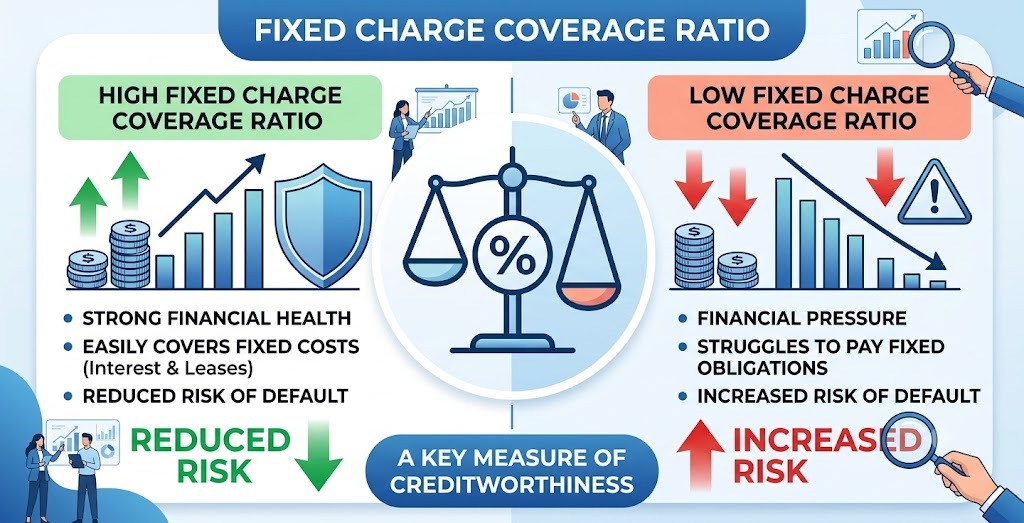
The fixed-charge coverage ratio measures a company’s ability to pay its fixed financial obligations with operating income (EBIT). Moreover, it shows how easily a business can cover costs such as interest and lease payments from its earnings. It includes both interest and fixed contractual payments, giving a more complete view of a company’s financial obligations.
A higher ratio indicates strong financial health and the ability to meet fixed costs even during economic changes comfortably. A lower fixed-charge coverage ratio signals financial pressure and a higher risk of default or liquidity problems. Overall, it is commonly used by banks and investors to assess a company’s creditworthiness and financial stability.
Importance of Fixed Charge Coverage Ratio
It plays a critical role in financial decision-making. It is widely used by banks, investors, and credit rating agencies.
Measures Financial Stability
It shows whether a company can meet its fixed obligations without financial stress.
Helps Lenders Assess Risk
Banks use the fixed-charge coverage ratio to determine loan approval and interest rates.
Supports Investment Decisions
Investors evaluate FCCR before investing in a company to avoid high-risk businesses.
Indicates Operational Efficiency
A strong ratio reflects efficient management of operating income and expenses.
5. Predicts Bankruptcy Risk
A low FCCR may indicate potential insolvency risk.
Interpretation of Fixed Charge Coverage Ratio
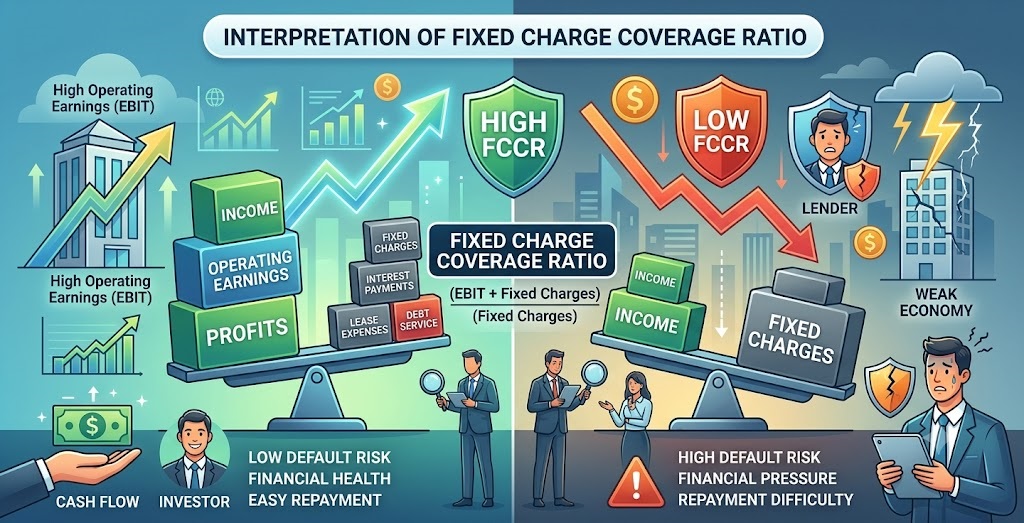
The fixed-charge coverage ratio measures a company’s ability to meet its fixed obligations with its operating earnings. However, a higher ratio indicates high income and a low risk of default, as the business can easily cover interest, lease payments, and other fixed costs.
A lower fixed-charge coverage ratio signals financial pressure and a higher risk of difficulty meeting fixed obligations during weak economic conditions. Overall, it is used by lenders and investors to evaluate creditworthiness, repayment ability, and overall financial health.
Components of Fixed Charge Coverage Ratio
The fixed-charge coverage ratio is calculated using three main components: EBIT, lease payments, and interest expense. EBIT, or earnings before interest and taxes, shows the company’s operating profit before financing costs and taxes are deducted.
Lease payments are recurring fixed obligations, such as rent or equipment lease costs. These payments are added back to EBIT in the numerator because the ratio measures how much income is available before fixed charges are paid. Interest expense is the cost of borrowing money and is included in the denominator because FCCR measures whether the company can cover both interest and lease obligations.
The formula is:
Fixed Charge Coverage Ratio = (EBIT + Lease Payments) ÷ (Interest Expense + Lease Payments)
For example, if a company has EBIT of $300,000, lease payments of $100,000, and interest expense of $50,000, the calculation would be:
($300,000 + $100,000) ÷ ($50,000 + $100,000) = 2.67
This means the company earns 2.67 times the amount needed to cover its interest and lease payments.
Moreover, it shows how well a company can generate sufficient earnings to cover all its fixed financial obligations. Lenders, investors, and analysts use it to assess a company’s creditworthiness and ability to repay debt. Moreover, it helps evaluate financial stability and risk, and compare performance across companies.
Fixed Charge Coverage Ratio vs Interest Coverage Ratio
Many people confuse the fixed charge coverage ratio with the interest coverage ratio. However, they are not the same.
| Feature | Fixed Charge Coverage Ratio | Interest Coverage Ratio |
| Includes lease payments | Yes | No |
| Measures total fixed obligations. | Yes | No |
| Accuracy in financial analysis | Higher | Lower |
| Complexity | More detailed | Simpler |
Applications of Fixed Charge Coverage Ratio
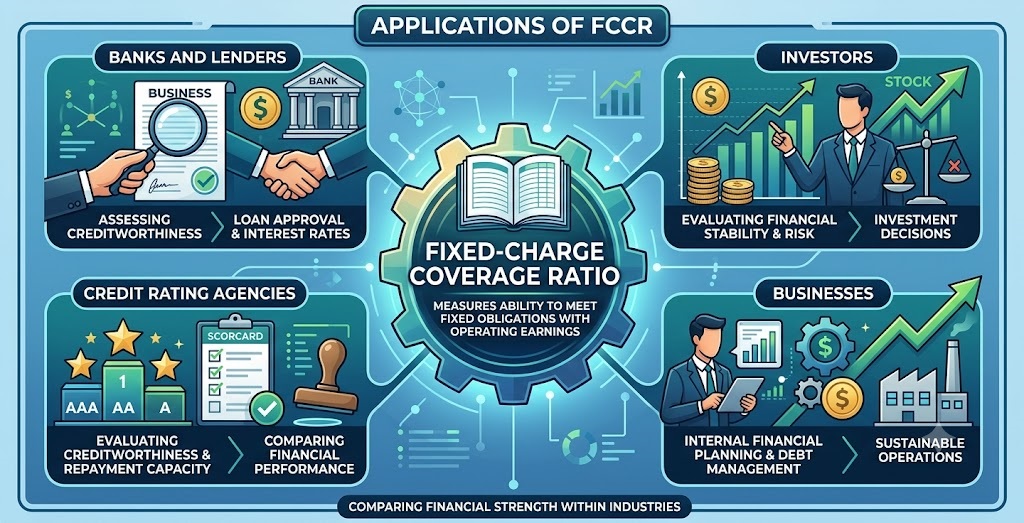
The fixed-charge coverage ratio is used in financial analysis to measure a company’s ability to meet its fixed obligations with operating earnings. Overall, Banks and lenders use it to assess creditworthiness before approving loans or setting interest rates.
Investors use the fixed charge coverage ratio to assess a company’s financial stability and risk before making investment decisions. However, Credit rating agencies also use it to evaluate creditworthiness and repayment capacity, as well as to compare financial performance across companies.
Additionally, businesses use the fixed charge coverage ratio for internal financial planning and debt management to ensure sustainable operations. Overall, it is also helpful for comparing the financial strength of companies within the same industry.
Factors Affecting Fixed Charge Coverage Ratio
The fixed-charge coverage ratio is influenced by financial and operational factors that affect a company’s ability to meet its fixed obligations. Moreover, a key factor is EBIT: higher operating income improves the ratio, while lower earnings reduce it.
Additionally, Interest expenses and lease payments raise fixed costs, which reduce the fixed charge coverage ratio. Overall, economic conditions, such as inflation or a recession, also affect revenue and cause fluctuations in the ratio.
A company’s capital structure and financial leverage affect the ratio, as higher debt levels typically lead to a lower fixed-charge coverage ratio. Operational efficiency and cost management also play a key role by influencing profitability and cash flow generation.
Advantages of Fixed Charge Coverage Ratio
- It helps measure a company’s ability to meet fixed financial obligations using operating income.
- It provides a more complete view of financial health by including interest and lease payments.
- It is useful for assessing creditworthiness before making lending or investing decisions.
- It helps investors and analysts evaluate financial risk and stability.
- It allows easy comparison of financial strength across different companies.
- It supports better financial planning and debt management decisions.
Fixed Charge Coverage Ratio in Financial Analysis
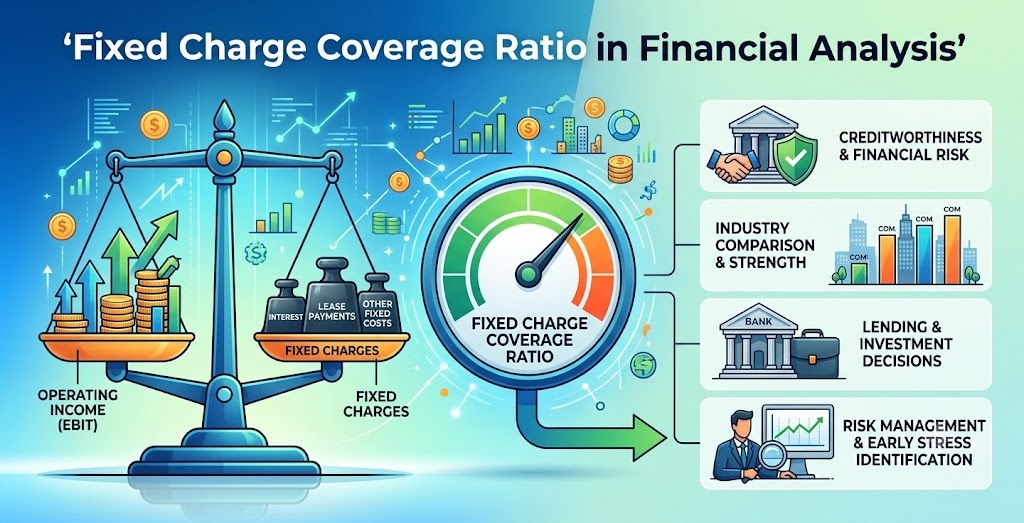
The fixed-charge coverage ratio measures a company’s ability to meet its fixed obligations with operating income. Overall, it helps investors, lenders, and analysts assess financial stability and coverage of interest, lease, and other fixed costs.
It is used to assess a company’s creditworthiness and financial risk. Moreover, it also helps compare financial strength and debt repayment capacity across companies in the same industry.
Additionally, the fixed-charge coverage ratio supports lending, investment, and financial planning decisions by indicating a firm’s ability to withstand economic fluctuations. However, it also helps identify financial stress early for better risk management.
Conclusion
The (FCCR measures a company’s ability to meet fixed obligations using operating income. Overall, it provides a clear view of financial stability by including both interest and lease payments.
Overall, FCCR is important in financial analysis, investment, and lending decisions as it reflects creditworthiness, risk, and efficiency. Moreover, a high FCCR indicates financial strength, while a low ratio indicates financial distress and weak long-term stability.
Additionally, it helps stakeholders compare companies within the same industry and evaluate debt management and financial performance. It also supports better decision-making by highlighting risk, efficiency, and financial resilience under changing economic conditions. For the full picture, read which helps enable an oligopoly to form within a market.
Apart from that, if you want to know more about Is Saturday a Business Day? Comprehensive Overview, Definition, Meaning, Exceptions for banks, for mail, and More info then visit our Finance category.
FAQs
The fixed-charge coverage ratio can be improved by increasing operating income (EBIT), cutting interest payments, reducing lease costs, improving operational efficiency, and reducing debt.
Indeed. It is frequently used to compare businesses in the same sector to assess overall stability, debt repayment capacity, and financial soundness.
A low ratio raises the possibility of financial difficulties, liquidity issues, or loan default, as it indicates the business might struggle to fulfil its financial obligations.