

A conflict of commitment occurs when external professional, academic, or personal activities interfere with primary job responsibilities. Moreover, it occurs when divided time and attention reduce effectiveness, productivity, and performance in the main role.
Additionally, it is commonly seen in universities, corporate offices, healthcare, and government organizations, where individuals take on extra roles or side work. Unlike a conflict of interest, it involves overextended time and responsibilities that reduce job performance and accountability.
This concept impacts individual performance, organizational success, and professional ethics due to financial pressure, career goals, and poor time management. However, if unmanaged, it leads to missed deadlines, burnout, and reduced work quality, underscoring the importance of balance and prioritization.
| Aspect | Explanation |
| Definition | A situation where external professional, academic, or personal activities interfere with primary job responsibilities. |
| Main Issue | Divided time and attention reduce performance, productivity, and effectiveness in the main role. |
| Common Settings | Universities, corporate offices, healthcare institutions, and government organizations. |
| Key Difference | Unlike conflict of interest, it focuses on overcommitment of time rather than financial or personal bias. |
| Major Causes | Overcommitment, financial pressure, poor time management, lack of rules, and desire for career expansion. |
| Main Effects | Missed deadlines, burnout, reduced productivity, lower work quality, and increased stress. |
| Individual Impact | Mental fatigue, reduced efficiency, poor performance, and job dissatisfaction. |
| Organizational Impact | Delayed projects, lower trust, reduced efficiency, and weak accountability. |
| Professional Risk | Poor evaluations, loss of credibility, and possible disciplinary actions. |
| Prevention Methods | Time management, setting boundaries, limiting extra work, and following workplace policies. |
| Real-Life Example | Teachers, employees, or healthcare workers managing side jobs along with full-time roles. |
| Financial Pressure Factor | Extra jobs taken due to financial needs leading to overwork and imbalance. |
| Importance | Improves ethics, productivity, accountability, and overall workplace balance. |
Definition of Conflict of Commitment
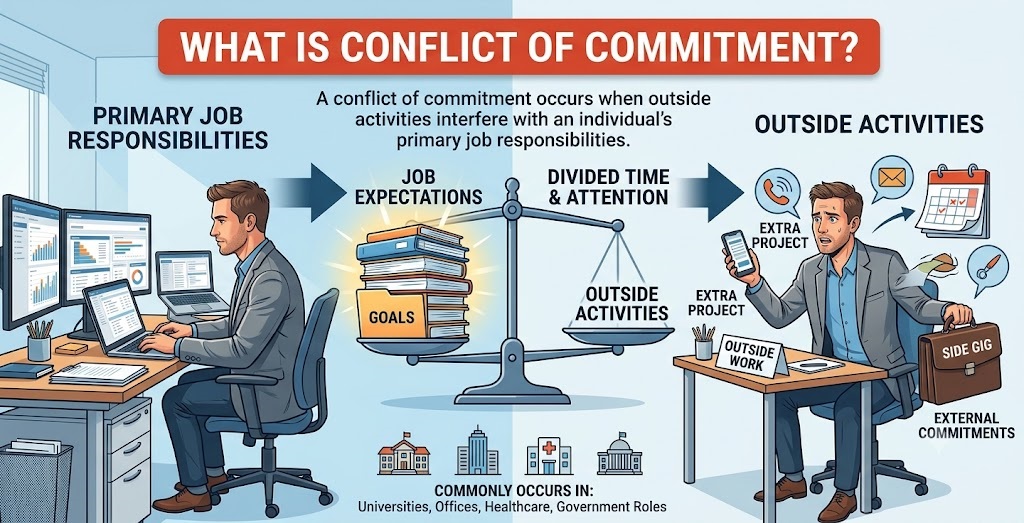
A conflict of commitment occurs when outside activities interfere with an individual’s primary job responsibilities. However, it results from divided time and attention, which reduce effectiveness in the main role.
Additionally, it commonly occurs in universities, offices, healthcare settings, and government roles when individuals take on extra work or responsibilities. Unlike a conflict of interest, it involves overcommitted time and effort that reduces performance in the primary job.
Causes of Conflict of Commitment
Several factors contribute to this issue:
Overcommitment
- Taking on too many jobs or responsibilities.
Financial Pressure
- Needing additional income from side work.
Poor Time Management
- Failure to organize tasks effectively.
Lack of Institutional Rules
- Some workplaces do not clearly restrict external work.
Career Expansion Desire
- Trying to grow multiple career paths at once.
Effects of Conflict of Commitment
It leads to reduced productivity, missed deadlines, lower work quality, and increased stress due to divided attention between multiple responsibilities.
On Individual Performance
- Missed deadlines
- Reduced productivity
- Mental fatigue and burnout
On Organization
- Lower quality output
- Reduced trust in employees
- Delays in project completion
On Professional Reputation
- Negative performance evaluations
- Loss of credibility
- Possible disciplinary action
How to Prevent Conflict of Commitment?

A conflict of commitment can be avoided by effectively managing time and prioritizing primary job responsibilities over secondary activities. Additionally, it also requires avoiding excessive roles, such as freelance projects or consulting work, that may interfere with main duties.
Following organizational policies, contracts, and ethical guidelines helps maintain professional standards and control outside work. Overall, Proper planning, disciplined scheduling, and self-assessment ensure that external activities do not affect primary job performance.
Conflict of Commitment in Real Life
Conflict of commitment in real life occurs when individuals take on multiple roles that interfere with their primary job responsibilities. Additionally, it is common among professionals such as teachers, employees, or healthcare workers who are distracted by side jobs or additional work.
This imbalance leads to missed deadlines, reduced work quality, fatigue, and increased stress. Additionally, it also harms organizations by lowering efficiency, delaying projects, and weakening accountability.
Financial Pressure
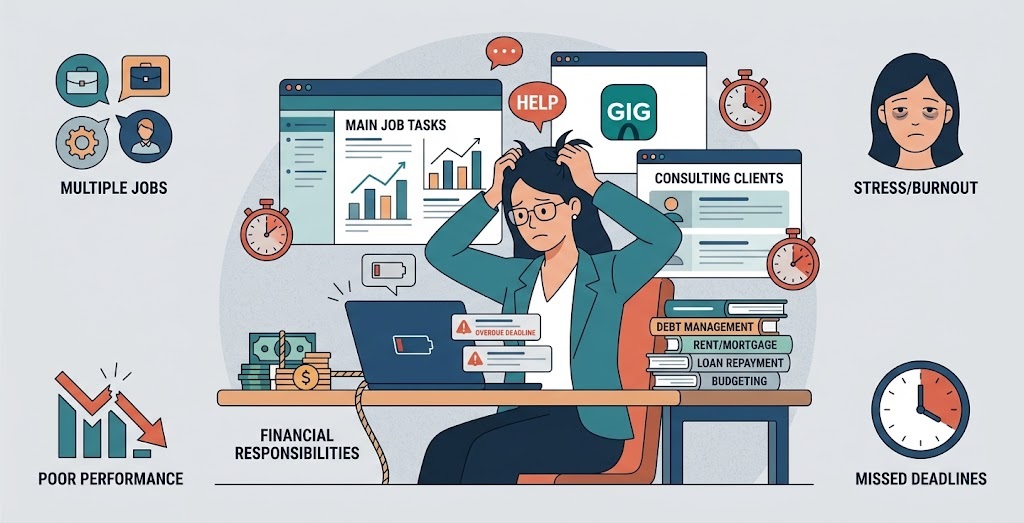
Financial pressure from a conflict of commitment occurs when individuals take on extra jobs or side work to meet financial needs, which interfere with their main job. Additionally, it often involves freelance work, consulting, or multiple jobs, all of which reduce time, focus, and performance in the primary role.
Rising living costs, debt, and financial responsibilities often push individuals to overcommit, making work-life balance difficult to maintain. Overall, this can lead to stress, burnout, missed deadlines, poor performance, and reduced workplace efficiency and accountability.
These situations highlight the importance of financial planning, prioritizing duties, and maintaining a balanced workload to avoid ethical conflicts. Additionally, they also stress setting boundaries, managing time effectively, and avoiding overcommitment to ensure productivity and work-life balance.
Importance
Understanding conflict of commitment is important because it promotes professionalism and accountability. Overall, addressing it helps ensure primary responsibilities receive proper attention and reduces ethical concerns.
It promotes effective time management, fair workload distribution, and better decision-making. Additionally, Managing conflicts of commitment also helps maintain trust, Transparency, and professional integrity across workplaces.
It reduces burnout, stress, and job dissatisfaction by encouraging a balanced approach to responsibilities. Moreover, preventing conflicts of commitment helps maintain trust, uphold ethical standards, and improve workplace efficiency.
| Feature | Conflict of Commitment | Conflict of Interest |
| Main Focus | Time and responsibilities | Personal or financial gain |
| Nature of Issue | Workload imbalance | Biased judgment |
| Problem Type | Performance-related | Ethics/decision-related |
| Example | Too many jobs affecting performance | Accepting gifts influencing decisions |
Career Expansion Desire
Career expansion desire conflict of commitment occurs when career growth activities interfere with primary job responsibilities. Additionally, it often results from taking on additional roles that require significant time and effort.
Excessive involvement in career growth opportunities can reduce focus, productivity, and commitment to the main role. Overall, it may also increase stress and workload pressure, making time management and prioritization essential.
Improve Time Management
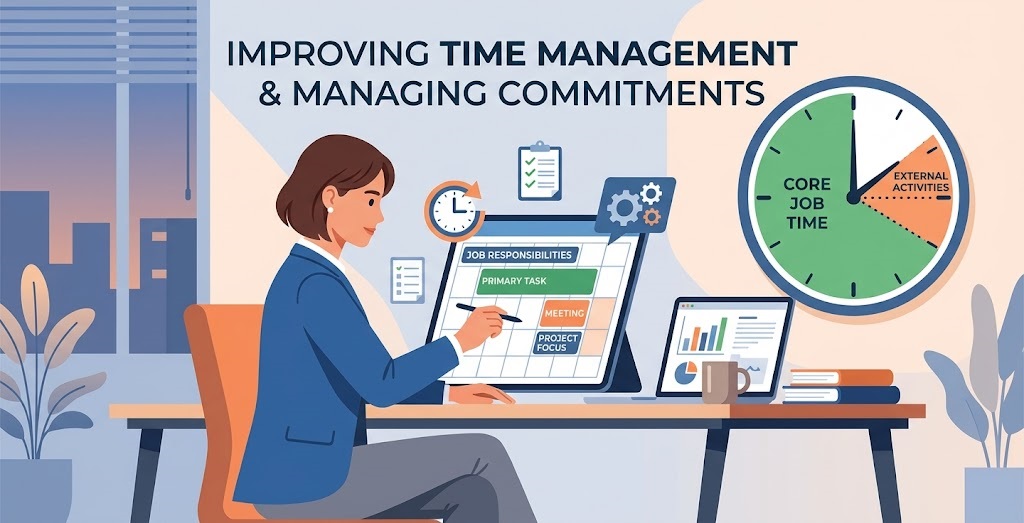
Improving time management in the face of conflicting commitments involves planning tasks effectively and prioritizing primary job responsibilities over secondary activities. Overall, it also includes using schedules and productivity tools to manage multiple roles without reducing performance.
Setting clear boundaries, avoiding extra commitments, and scheduling specific time slots help maintain focus and efficiency. Additionally, Regular self-evaluation and disciplined workload management ensure that external activities do not affect core job responsibilities.
Benefits
- Encourages individuals to recognize and correct poor time management habits
- Helps improve focus on primary job responsibilities
- Promotes better work-life balance through awareness of overcommitment
- Enhances productivity by reducing unnecessary workload distractions
- Supports ethical decision-making in professional environments
- Improves organizational efficiency and accountability
- Encourages proper prioritization of tasks and responsibilities
- Helps prevent burnout by identifying excessive workload early
Conclusion
In conclusion, conflict of commitment occurs when external activities interfere with primary job responsibilities. Moreover, it negatively impacts productivity, ethical standards, workplace efficiency, and overall professional performance.
Understanding its causes, effects, and preventive strategies helps individuals identify early warning signs and manage workload effectively. However, it also promotes time management, prioritization, ethical decision-making, and adherence to organizational policies for fairness and accountability.
By managing commitments responsibly, professionals can reduce stress, avoid burnout, maintain trust, protect their reputation, and achieve long-term career growth, stability, and work-life balance.
Apart from that, if you want to know more about then visit our Education category.
FAQs
Professionals in higher education, healthcare, corporate employment, and government are most impacted.
It is crucial because it upholds professionalism, boosts output, ensures ethical behaviour, and promotes a better work-life balance.
While conflict of interest refers to financial or personal interests that could influence decision-making, conflict of commitment refers to imbalances in time and workload.Bottom of Form